
This is my third post continuing with the theme of finding inspiration to boost our own creativity. Please think about how these photos impact your head, heart and gut intelligence centers. How does each voice speak to you when you consider them?
When I need inspiration to kick-start creativity it helps me to look up… I am mesmerized when I think about riding in our Milky Way galaxy— home to 400 billion stars and our own moon, sun and solar system. Our spiral galaxy is nearly 120,000 light-years across and is a fairly typical barred spiral–with four major arms in its disk, at least one spur, and a newly discovered outer arm. The galactic centre, which is located about 26,000 light-years from Earth, contains at least one supermassive black hole (called Sagittarius A*).
The Milky Way began forming around 12 billion years ago and is part of a group of about 50 galaxies called the Local Group. The Andromeda Galaxy is part of this group as are numerous smaller galaxies, including the Magellanic Clouds. The Local Group itself is part of a larger gathering of galaxies called the Virgo Supercluster of galaxies. Is your head spinning yet? We belong to a ginormous neighborhood of galaxies.
Lets delight in some of the most amazing views of our Milky Way galaxy ever captured by amateur and professional astronomers… or “MW” as I affectionately say.

Image of the night sky above Paranal, Chile on 21 July 2007, taken by ESO astronomer Yuri Beletsky. A wide band of stars and dust clouds, spanning more than 100 degrees, is seen. At the centre of the image, two bright objects are visible– the planet Jupiter and the star Antares.

During a road trip in 2015 to a wedding Mark Lehrbass spent the night out of Snoqualmie Pass, WA. “Epic light pollution from Seattle’s suburbs, multiple wild fires, and the 90 interstate winding through the mountains made for some incredible lighting to frame Mt. Ranier and the Milky Way rising above it,” he said. All I can say is WOW…

Here MW glows over an old windmill in this stunning image shot by an amateur astronomer and astrophotographer Sean Parker. This (14-shot panoramic view) is over Paulden, Ariz. The planet Jupiter, bright star Sirius, constellation Orion and open star cluster–the Pleaides–can also be seen toward the right in the photo.

In 2014, astrophotographer Shreenivasan Manievannan photographed MW arching over a rock arch in Joshua Tree National Park, California.

The Milky Way and green airglow are captured over the Isle of Wight in this image taken by Chad Powell on Oct. 4, 2013.

MW is seen in all its glory, as well as, in the lower right, the Large Magellanic Cloud. Credit: ESO/S. Guisard

The bright Perseid meteor streaked through skies in Hungary on August 8, 2010. In the foreground is the Church of St. Andrew ruin, with bright Jupiter dominating the sky to its right. Two galaxies lie in the background: our own MW, and the faint smudge of the more distant Andromeda Galaxy just above the ruin’s leftmost wall.

A view of MW toward the constellation Sagittarius (including the Galactic Center) as seen from the Black Rock Desert, Nevada). The bright object on the right is Jupiter, just above Antares. Photo by Steve Jurvetson.

MW arching from the Cerro Paranal, Chile, on the left, and sinking into the Antofagasta’s night lights. The bright object in the center, above the Milky Way is Jupiter. The Magellanic Clouds are visible on the left side, and a plane has left a visible trace on the right, along the Vista enclosure. Photo by Bruno Gilli/ESO.
This detailed artist’s impression shows the structure of MW below, including the location of the spiral arms and other components such as the bulge. This image includes the most recent mapping of the shape of the central bulge from survey data from ESO’s VISTA telescope at the Paranal Observatory, credit NASA/JPL-Caltech/ESO/R. Hurt.

Where is our sun relative to our gigantic MW neithborhood?

Yes our sun is located close to the “Orion Spur.” In my own sky above Santa Fe, New Mexico–I can always depend on finding Orion! The constellation is located on the celestial equator and visible throughout the world, named after a Greek hunter in mythology.
Lastly photographer Antoni Cladera shows why “shooting the Milky Way is contagious” with photo below.

Our Milky Way is just one of countless galaxies in the universe. Our view of the universe is expanding. Less than a century ago, astronomers thought that our Milky Way galaxy of stars might be the whole universe. Today, we can observe the splendor of galaxies far beyond our own. We can see the estimated 100 billion galaxies that make up our “observable universe.”
We are all creative creatures living in a God ordained, ever-creative, and expanding universe. How is your head, heart and gut inspired by these photos in distinctive ways? Which is your favorite and why?
Thanks for reading my post. I am an organizational and business consultant living in the mountains of Santa Fe, New Mexico with my husband and dogs. My core message of everyone is creative resonates with people of all ages and walks of life. I invite all to become the best version of themselves in my book and find true meaning by pursing long term creative quests.


 A wide-eyed baby Orangutan takes in the new world around him from the safety of mom’s embrace (Chin Boon Leng, 2014 Sony World Photography Awards).
 Dainan Zhou, China, Entry, Open Competition, 2015 Sony World Photography Awards.
 The knight and his steed, a tropical capture in Costa Rica. Nicolas Reusens, 2014 Sony World Photography Awards.
 Yes, these two truly are BFF’s.

 This photo of two lowland gorillas was taken at the Bronx Zoo in New York City. This is part of a series of photos called Bronx Zoo Diaries.
 National Geographic photo of a mother humpback whale and baby dive in Pacific waters off Maui. There is a documented account of a humpback sweeping a seal on its back, away from attacking killer whales.
 Keeper Julius Latoya shares a tender moment with Kinna, a young orphaned African Elephant at the David Sheldrick Wildlife Trust in Tsavo East National Park, Kenya. GERRY ELLIS, MINDEN PICTURES.
 Zeybeks by Hasan Baglar: Zeybek is a Turkish traditional folk dance … “It’s a normal behavior of praying mantis, they are doing defense and both of them doing the same dance…”
 Sony-world-photography-awards-2015-shortlist



 Some personalities are drawn to creativity like a moth is drawn to a hot light bulb. You’d rather burn up in the beauty of your creativity—as compulsively as the moth—than live a long life. You are at one end of the spectrum. Another may believe they don’t have a creative cell in their body, but wish they had some passion for something—like that moth. Where are you on this spectrum?

 The intersection(s) of our three centers of intelligence are sources of creativity. The goal is for one center not to suffocate the other two centers, but instead to unite by creating intersections. When one allows the cross-pollination of intelligence centers, the synergy creates something entirely new. This point of union yields untapped potential. Like the shamrock, it blossoms. The fruit of its existence emerges as a new yellow arrival—a happy flower shining brightly in the sun… anywhere, anytime!
 Here are three ground breaking stories highlighting women’s creativity in three different countries. One story is creativity in a business sense (China), another a political paradigm breaking case (Sweden), and a third story
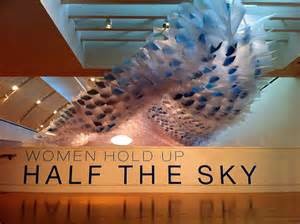 famously said “women hold up half the sky” (1952).
 An exemplar is Zhou Qunfei– The world’s richest self-made woman (Forbes). She is the founder of Lens Technology, which went public last year, and is worth $7.2 billion. Her two biggest customers are Apple and Samsung. Lens Technology is a leading supplier of the cover glass used in laptops, tablets and mobile devices. This is no easy manufacturing task, check out how thin 0.5 millimeters is on a ruler, and you’ll understand how hard it is to create something this thin.
 Sweden has the highest proportion of women parliamentarians in Europe
 paradigm-breaking entrepreneur, Madame C.J. Walker (1867-1919). Far before she had the right to vote, she was inspired by a dream making her the FIRST American female self-made millionaire (and she was African American). She created a line of hair-care and skin products for black women. Walker was suffering from a scalp infection causing her to lose most of her hair in the 1890s. She began experimenting with patented medicines and hair-care products. Then she had an intuitive dream that solved her problems (gut center creativity). “He answered my prayer, for one night I had a dream, and in that dream a big, black man appeared to me and told me what to mix up in my hair. Some of the remedy was grown in Africa, but I sent for it, mixed it, put it on my scalp, and in a few weeks my hair was coming in faster than it had ever fallen out. I tried it on my friends; it helped them. I made up my mind to begin to sell it.” Madame Walker proves the old adage “go sleep on it”, when needing to solve a personal or work problem, is good creative advice.


